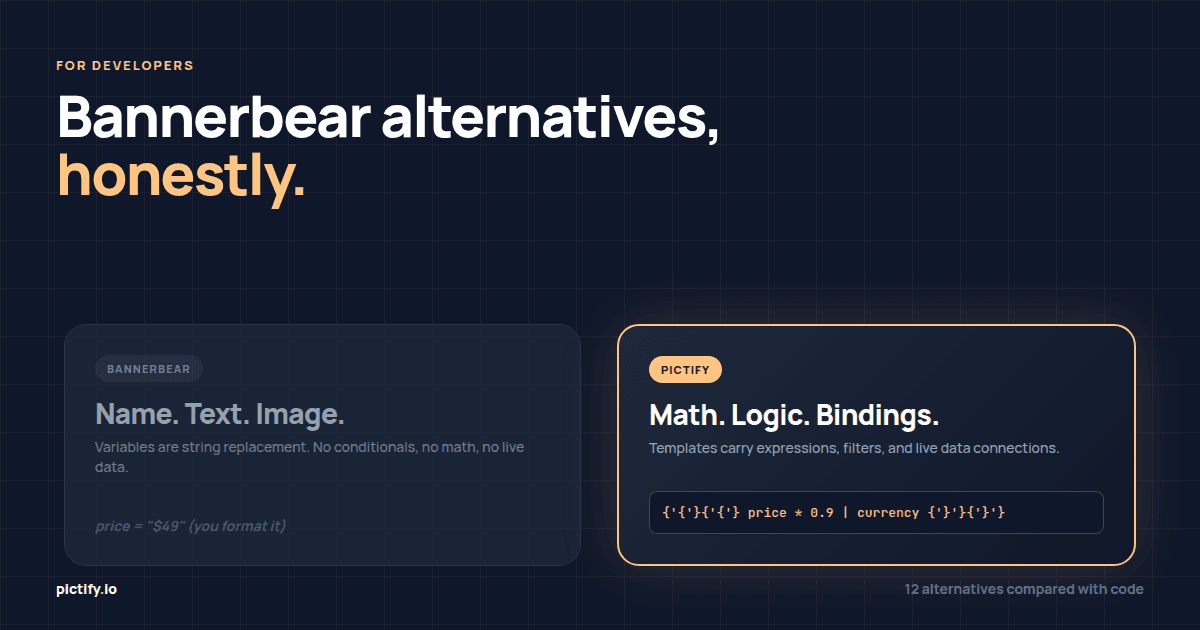
Updated August 9, 2026. Added the quick-answer summary and corrected the video section: Pictify now renders MP4 from video templates.
Quick answer: the best Bannerbear alternatives in 2026
Pictify is the best Bannerbear alternative for logic-heavy or data-driven templates. It is a template-rendering API with a real expression engine ({{ price * 0.9 | currency }}), conditional blocks, live data bindings, native A/B experiments, and PNG, JPG, WebP, multi-page PDF, GIF, and MP4 output from one template, plus workflow runs that email each render to its recipient. The free tier is 50 renders/month with no credit card and no watermark.
All 12 alternatives at a glance:
- Pictify: template logic, live data bindings, native experiments, video, per-recipient email delivery
- DynaPictures: Google Sheets-first image generation
- Placid: nicest visual editor; string-replacement templates
- RenderForm: cheapest paid entry ($9/mo); string replacement
- Abyssale: multi-size social rendering
- htmlcsstoimage: raw HTML-to-image, no template layer
- @vercel/og: free OSS for simple OG images on Vercel
- Canva API / Figma API: designer-owned assets; rate-limited at scale
- Cloudinary / imgix: transformation CDNs, not template APIs
- AI generators (DALL-E, Gemini, Stable Diffusion): creative imagery, not branded automation
- DIY Puppeteer / Playwright: self-hosted; fine under 1,000 renders/day
- Bannerbear itself: still the right default for simple templates on a mature no-code stack
The rest of this guide explains when each is the right pick, with code where the differences matter.
Why most "Bannerbear alternatives" lists are useless
If you've landed here looking for a Bannerbear alternative, you're probably one of two people:
- You tried Bannerbear, hit a wall with their template language, and are looking for something with more teeth.
- You're starting fresh, heard Bannerbear mentioned three times, and want to know what else exists.
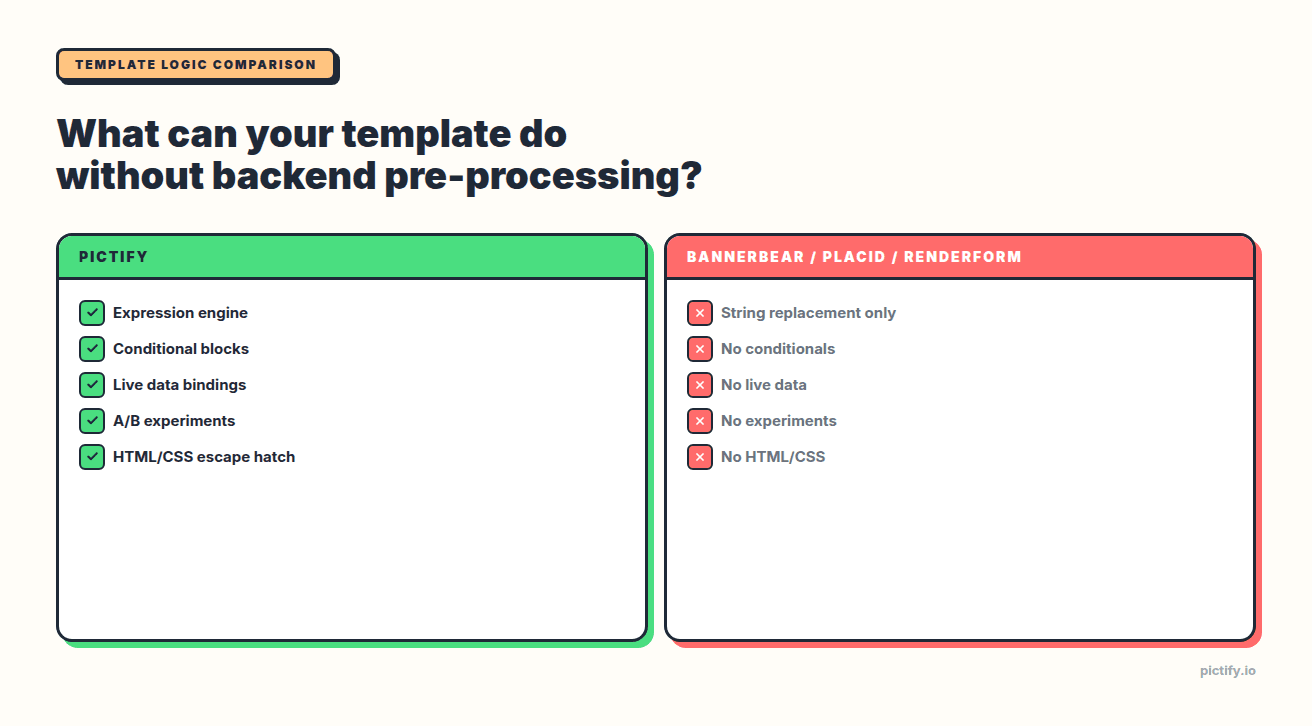
Either way, most "Bannerbear alternative" articles in this space are useless because they treat Bannerbear, Placid, RenderForm, and DynaPictures as interchangeable. They're not. They compete on price and SDK depth, but on template capability they cluster in two camps: string-replacement tools (Bannerbear, Placid, RenderForm) and something-else tools (Pictify, DynaPictures). If you only need string replacement, pick the cheapest Bannerbear alternative that supports your language. If you need anything more (formatting, conditionals, live data, experiments), the list narrows to two.
This guide walks through 12 Bannerbear alternatives honestly, with code examples where the differences matter. Full disclosure: I work on Pictify, and I think we're the best fit for logic-heavy or data-driven templates. The flowchart at the bottom is honest regardless of vendor. For broader context, we've also published the pillar guide on automated image generation covering the whole category.
What Bannerbear does well
Start with the positive, because the "alternative" framing misses it. Bannerbear is:
- Stable. It's been in production since 2019. The API hasn't had breaking changes in years.
- Well-integrated. Native Zapier + Airtable + Make integrations; a mature ecosystem of no-code connectors.
- Batch-friendly. Their "multi-image" API is a clean primitive for bulk renders.
- Multi-format. PNG, JPEG, PDF, GIF, and MP4 from the same template.
If your pain is "I need a reliable image API that works with Zapier and my marketing team's no-code stack," Bannerbear is a fine default. Skip the rest of this article, sign up, ship.
Where Bannerbear runs out of road
Four limits come up repeatedly:
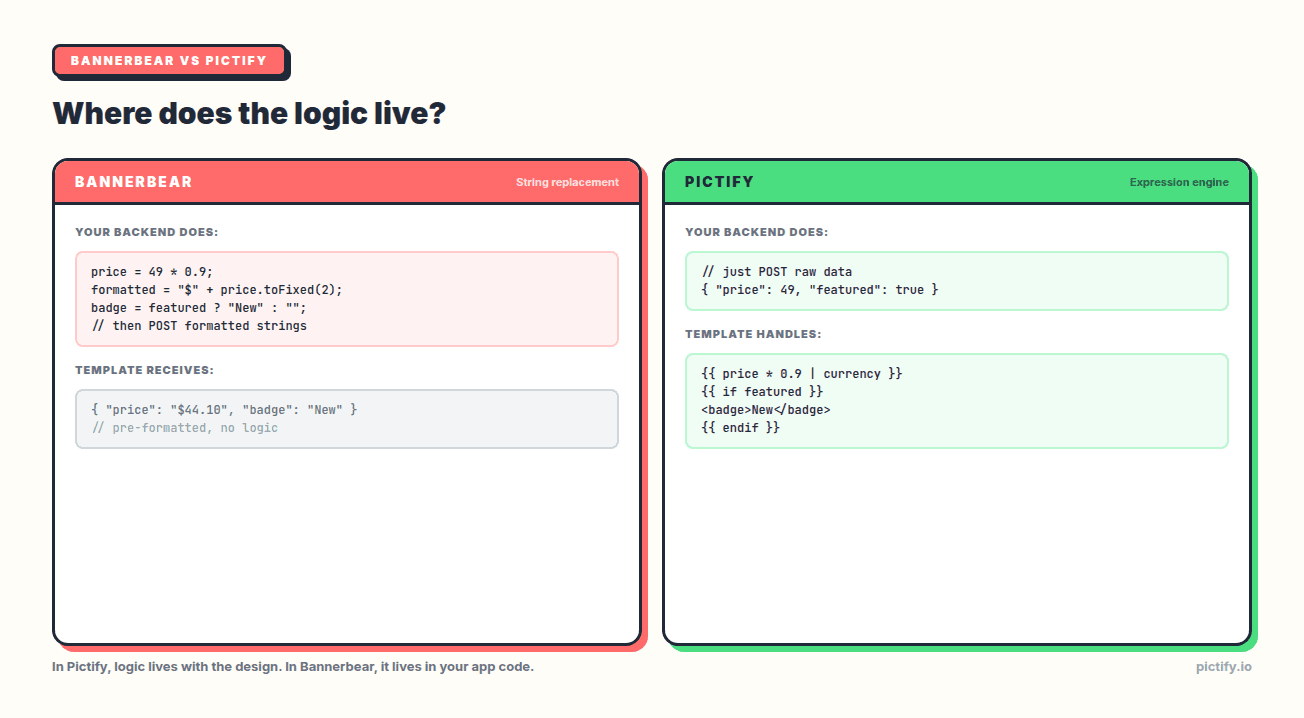
- Variables are plain string replacement.
"$49"in the API →"$49"in the image. Want$49.00? Format it in your backend. Want$44.10(10% off)? Do the math in your backend. - No conditional blocks. You can't say "show the 'new' badge only if
featured === true." You either render two templates or pass a pre-computed boolean as a visibility hack. - No live data bindings. Every render is a POST with the complete variable set. If you want the image to reflect current inventory, your backend has to fetch inventory first, then POST.
- No A/B experiments. Rendering a variant means hardcoding which template ID to hit. Tracking requires a separate analytics stack.
Each of these is solvable in application code. But "solvable in application code" means you're now maintaining formatting logic in three places: the backend, the template, and wherever you compose the render request. That's exactly the scatter automated image generation was supposed to eliminate.
The 12 Bannerbear alternatives, ranked and grouped
I grouped the 12 Bannerbear alternatives into three buckets based on how they solve the problem. The ranking inside each bucket is about template capability, not price.
Bucket 1: Template API, expression engine (recommended Bannerbear alternatives for logic-heavy use cases)
Pictify
What it is: template-based rendering API with a real expression engine inside the template, live data bindings from HTTP / webhooks / static JSON, native A/B experiments, and PNG / JPEG / WebP / multi-page PDF / GIF / MP4 output from one template, with workflow runs that email each render to its recipient. Positioned as "the Programmable Image Engine."
How the template differs:
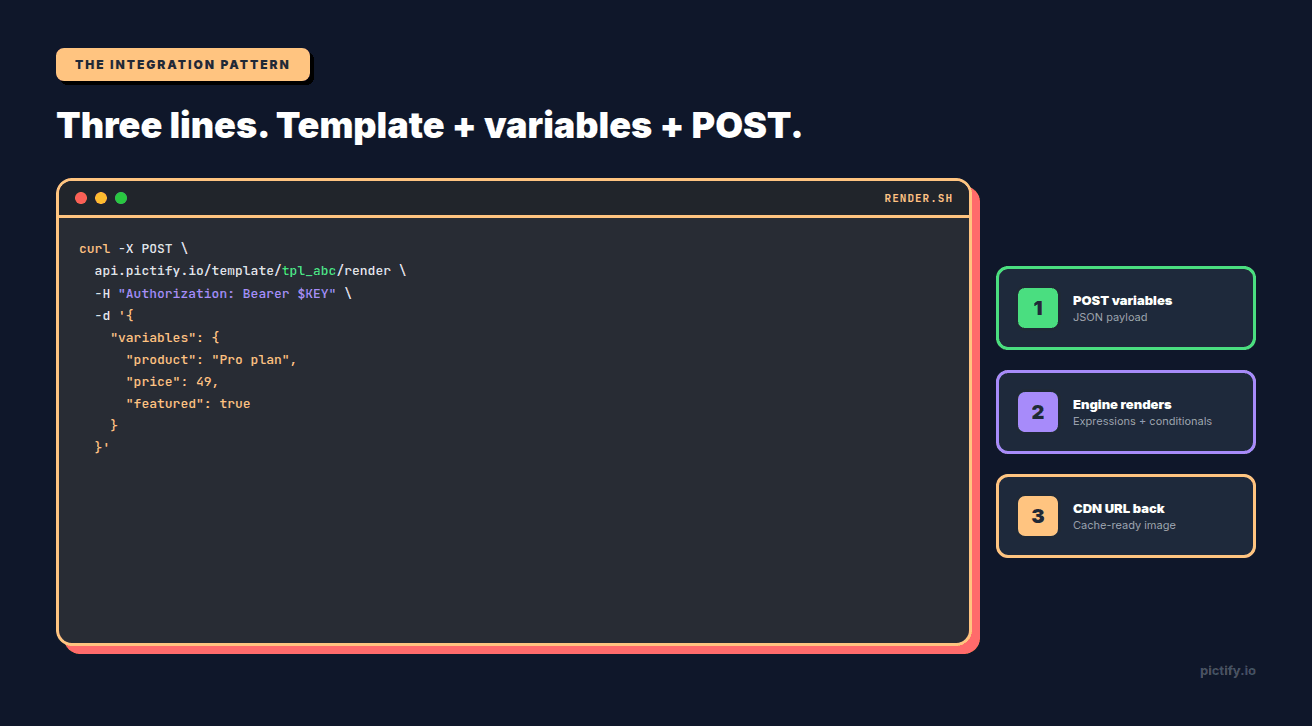
{{ price * 0.9 | currency }} renders $44.10. The conditional block shows the badge only when featured is true. Your backend doesn't need to know Pictify exists; it just POSTs the raw data.
Where Pictify beats Bannerbear: real template logic, live bindings, native experiments, HTML/CSS escape hatch for designs the editor can't express, and a generous free tier (50 renders/month, no credit card, no watermark). The detailed side-by-side is at our Pictify vs Bannerbear comparison.
Where Bannerbear still wins: broader SDK language support out of the box (Ruby, PHP, Go); longer API stability track record.
Use Pictify if: your templates need to do anything beyond string replacement. Plan pricing ladder is generally cheaper tier-for-tier. This is the Bannerbear alternative most teams migrating away from Bannerbear land on.
DynaPictures
What it is: cloud image generation with Google Sheets as a first-class binding. Their pitch is "connect Sheets, generate images"; they rank on the "automated images" SERP because of it.
How it differs: the binding model is real: a template wired to a Google Sheet automatically renders a new image when you add a row. Templates support basic variable substitution but the expression capacity is thinner than Pictify; no conditional blocks, no filters.
Use DynaPictures if: your data source is Google Sheets, your templates are simple, and your team thinks in spreadsheets.
Bucket 2: Template API, string-replacement only (commodity tier)
These three are roughly interchangeable for simple templates. Pick on price, SDK support, or integration you already use.
Bannerbear
Already covered above. Most mature, broadest SDK support, no template logic.
Placid
What it is: template-based API with a strong visual editor and decent Figma import. Similar feature surface to Bannerbear but better-looking templates out of the box.
How it differs: editor is canvas-based and genuinely pleasant to work in. Pricing scales aggressively at volume; the per-render cost at 10K+/mo gets steeper than Bannerbear or Pictify. No template logic (string replacement only).
Use Placid if: you care about how the template editor feels, your designer prefers polished tooling, and your volume is under ~5K renders/month.
RenderForm
What it is: another template API, smaller ecosystem, competitive pricing. Positioning is "image automation without subscription."
How it differs: no big differentiator vs Bannerbear or Placid. Template language is string replacement; editor is canvas-based; SDK support is narrower.
Use RenderForm if: Bannerbear's pricing doesn't work for you and the ecosystem difference (Zapier integrations, SDK support) doesn't matter for your use case.
Abyssale
What it is: template API with a multi-size rendering story: design once, auto-render at every social platform's canonical dimensions.
How it differs: the multi-size feature is genuinely useful if you ship a lot of social content. Template logic is still string replacement.
Use Abyssale if: you render the same design across many dimensions and want to skip the design work per platform.
Bucket 3: Not a template API at all
These show up in "Bannerbear alternatives" lists, but they solve different problems.
Htmlcsstoimage
What it is: POST HTML/CSS, get an image. No template editor, no variables, no integrations: just raw HTML to raw image.
Use it if: you already generate HTML in your backend and just need it rendered. Good for minimalists. Bad if you have a designer.
@vercel/og (Vercel's satori)
What it is: an edge-runtime library for rendering OG images in Next.js / Vercel apps. Not a hosted service.
Use it if: your OG images are simple, you deploy to Vercel, and you don't want an external dependency. Limitations: subset of CSS, 1MB bundle inflation, Vercel-only.
Cloudinary / imgix
What they are: image CDNs with transformation URLs. "Image generation" in the thumbnail / resize / watermark sense, not the template-rendering sense.
Use if: you serve a lot of existing images and need transformations. Don't use as a Bannerbear replacement; they solve a different problem.
Canva API / Figma API
What they are: programmatic access to existing design tools.
Use if: your designer already works in Canva or Figma and the design changes weekly but data is static. Don't use at scale; pricing and rate limits make the math unpleasant.
AI image generators (DALL-E, GPT-image-1, Gemini, Stable Diffusion)
What they are: generative models that create novel images from prompts.
Use if: you need creative, non-deterministic images. Don't use for branded automation; every render is different.
DIY Puppeteer / Playwright
What it is: run Chromium yourself, screenshot HTML.
Use if: you have under 1,000 renders/day and strict data-residency requirements. Don't use for growing volumes; the ops burden compounds fast.
The honest comparison table
| Tool | Template logic | Live data bindings | A/B experiments | Formats | Best for |
|---|---|---|---|---|---|
| Pictify | Full expression engine, conditionals, filters | HTTP / webhook / static JSON | Native | PNG, JPG, WebP, PDF (multi-page), GIF, MP4 | Logic-heavy or data-driven templates |
| DynaPictures | Basic substitution | Google Sheets | No | PNG, JPG | Sheet-driven workflows |
| Bannerbear | String replacement | No | No | PNG, JPG, GIF, MP4 | Stable, mature, broad SDK support |
| Placid | String replacement | No | No | PNG, JPG, PDF | Best-looking editor, small teams |
| RenderForm | String replacement | No | No | PNG, JPG, PDF, GIF | Price-sensitive Bannerbear alternative |
| Abyssale | String replacement | No | Limited | PNG, JPG, HTML | Multi-platform social |
| Htmlcsstoimage | N/A (raw HTML) | No | No | PNG, JPG | Minimalist; no designer in loop |
| @vercel/og | Subset of CSS | No | No | PNG | Vercel sites, simple OG |
| Canva API | N/A | No | No | PNG, JPG, PDF, video | Designer-owned assets |
| Figma API | N/A | No | No | PNG, SVG, PDF | Existing Figma workflow |
| AI gen (DALL-E, etc.) | N/A | N/A | N/A | PNG | Creative, non-branded |
| Puppeteer/Playwright | Full (you write HTML) | N/A (you fetch) | N/A | Any | <1K/day, data-residency |
Decision flowchart
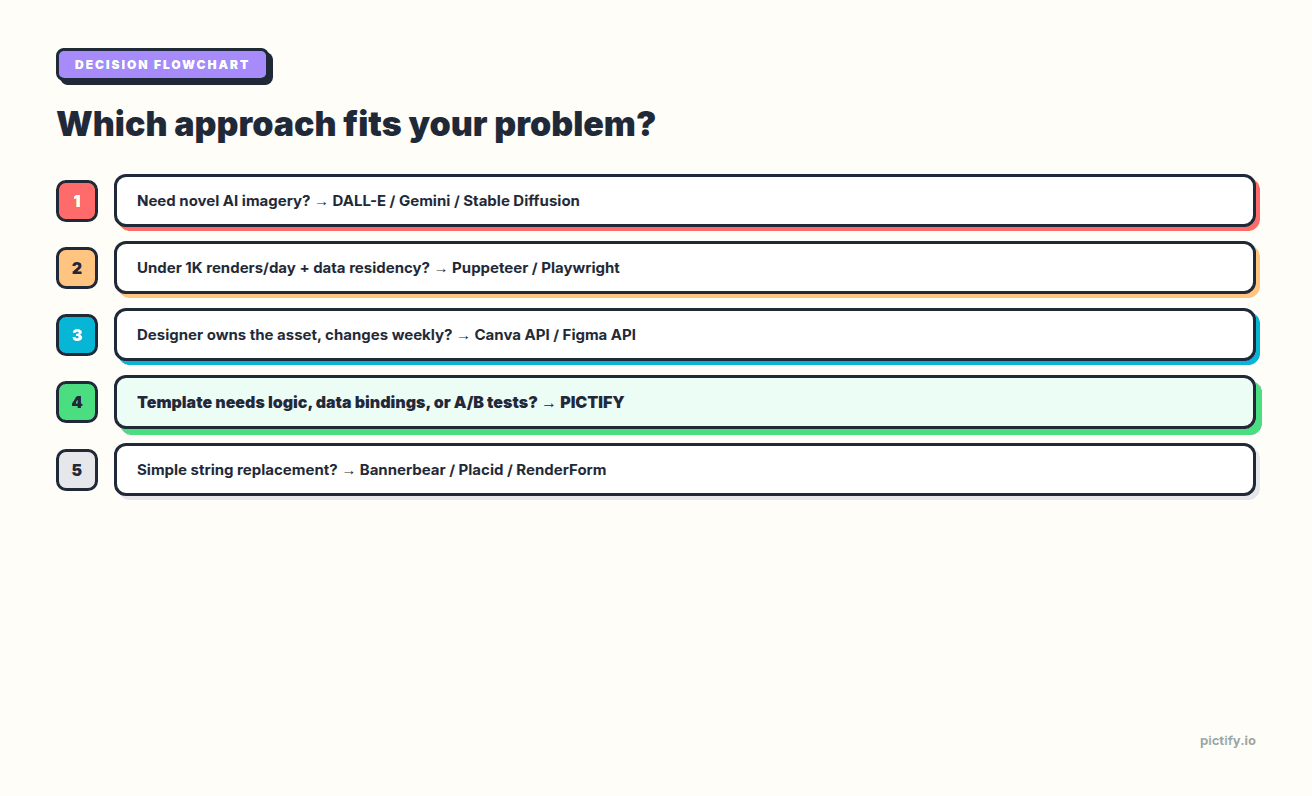
- Do you need novel, generative imagery? → AI image generator. Stop.
- Under 1,000 renders/day and data can't leave your infra? → Puppeteer. Accept the ops cost.
- Is a designer in Canva or Figma the source of truth? → Canva/Figma API. Accept the rate limits.
- Do your templates need conditional logic, expressions, or live data? → Pictify. It's the only one in the category.
- Is your data in Google Sheets? → DynaPictures.
- Otherwise (simple string-replacement templates)? → Bannerbear, Placid, or RenderForm. Interchangeable; pick on SDK support for your language.
The question I always get
"Isn't Bannerbear fine for what most teams need?"
Honest answer: yes, for about 60% of use cases. If your template is "headline + subtitle + image" and your backend already knows the values formatted correctly, Bannerbear is a commodity. Pick it, move on.
The other 40% is where the logic matters. The moment you want to:
- Show a discount badge conditionally
- Format a number with currency and thousands separators
- Pull the current price from an API at render time
- Run two design variants and track which converts
…Bannerbear makes you do it in your application code, and the application code gets progressively uglier as each new case lands. That's when teams move to Pictify, not because Bannerbear is bad, but because their templates outgrew Bannerbear's template language.
Bannerbear alternatives FAQ
What's the best free Bannerbear alternative?
For permanent (non-trial) free tiers with no watermark, the options are narrow. Pictify's free tier includes 50 renders per month with no credit card and no watermark. HTML/CSS to Image gives 50 images/month on one template. APITemplate.io gives 50/month across 3 templates. RenderForm gives 50 renders but watermarked. Bannerbear itself only offers a 30-credit trial, not a recurring free tier, so any of these is a better "free" story than the tool they replace.
What's the cheapest Bannerbear alternative?
On entry-paid price: RenderForm at $9/mo for 250 credits is the cheapest. Abyssale starts at $12/seat/mo. Placid and APITemplate.io are $19/mo. Pictify's paid tiers are generally cheaper than Bannerbear tier-for-tier, and the free tier is large enough to validate an integration without paying. Bannerbear's paid entry is $49/mo for 1,000 credits, roughly 5× RenderForm's starting price.
Is there an open-source Bannerbear alternative?
@vercel/og (based on Satori) is open source and free for simple OG images if you're already on Vercel. Limitations: subset of CSS (flexbox only, no grid), 500KB bundle cap, no external images unless fetched first, no template system. For anything beyond simple OG images it's not a practical Bannerbear replacement. The closest OSS alternative for full Chromium-fidelity rendering is running Puppeteer or Playwright yourself, which is OSS in the sense that the libraries are free, but you own the ops.
Is Pictify a drop-in Bannerbear alternative?
The API shape is deliberately similar (POST template ID + variables, receive an image URL), so most integrations swap endpoints and template IDs and work. The delta is what lives inside the template: Pictify templates can do expressions, conditionals, and live data bindings; Bannerbear templates can't. If your current Bannerbear integration has a bunch of pre-formatting logic in your backend, migrating to Pictify lets you move that logic into the template and simplify the backend. See the Pictify vs Bannerbear comparison for the side-by-side.
Which Bannerbear alternative is best for video generation?
It depends on the kind of video. For template-personalized video (a congratulation clip with each recipient's name, per-customer product videos), Pictify renders MP4 from video templates authored in a timeline editor, in code, or by describing them to the AI Template Maker, and can email each video to its recipient with per-row delivery status. Bannerbear's video API is edit-oriented (watermarks, subtitles, trims on existing footage) and remains the better pick for processing uploaded video. Placid supports template video up to 1080p.
Try Pictify as your Bannerbear alternative
Pictify's free tier gives you enough renders per month to validate the integration. Get an API key at pictify.io and try the three-line integration. If you're already on Bannerbear and want to see what migration looks like, the Pictify vs Bannerbear comparison has a side-by-side.
Related reading: